


Centring is the first skill you learn on the wheel and the one that takes longest to feel natural. It is also the skill that decides everything afterwards. A well-centred ball of clay opens evenly, pulls into walls of consistent thickness and stands up under its own weight. Clay that is slightly off centre will fight you for the rest of the pot — one side thick, one side thin, a rim that dips as it turns, a form that collapses at the worst possible moment.
The good news is that centring is a physical skill, not a mysterious talent. It comes down to a handful of positions and pressures, repeated until your hands recognise the feeling. Here is how to get there.
What Centring Actually Means
Centring does not just mean the clay sits in the middle of the wheel head. It means the whole mass is spinning around the wheel's true axis, with no wobble. If you rest a wet palm against the side of a centred ball while the wheel turns, you feel nothing but smooth, even pressure. If the clay is off centre, you feel a thump once every revolution — the high side coming round to meet your hand.
That thump is your teacher. Learn to feel for it and you will know within seconds whether you need to keep working.
Set Up Before You Touch the Clay
Most centring problems start before the wheel turns. Sort these out first.
- Seat height. Your elbows should brace comfortably against your thighs or the rim of the splash pan, with your forearms roughly level. Too high and your arms tire; too low and you lose the leverage that does most of the work.
- Wheel speed. Centring wants speed — medium to fast. Slow the wheel down once the clay is centred and you start opening.
- Clay size. Begin with around 500g to 1kg. Larger balls demand more strength and more control than most beginners have in their first month.
- Wedging. Wedge the clay properly to remove air pockets, then shape it into a rounded ball. Air trapped inside will show up later as a blowout or a bump you cannot chase out.
- Water. Have a bowl within reach, but use it sparingly. A slick, sloppy surface makes the clay hard to grip and easy to push off centre.
Slap the ball down firmly onto the wheel head, slightly off-centre is fine, and press it down so it sticks. Give the wheel a spin and check it is not about to fly off.
Body Position: The Part Beginners Underestimate
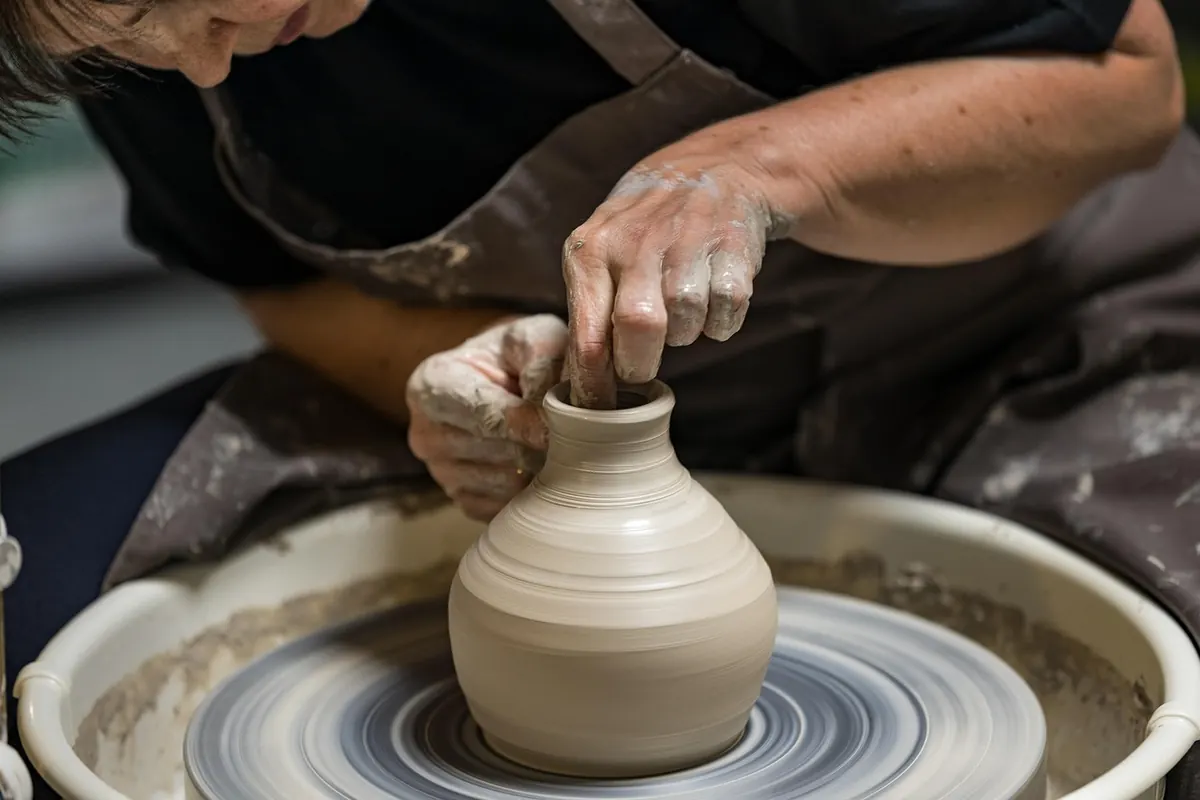
Centring is done with your body, not your hands. Your arms are the connection; your weight is the power.
Sit close to the wheel, so close that your knees are almost touching the splash pan. Brace your elbows against the inside of your thighs or against the pan itself. From there, you can lean in and let your upper body weight travel down through your forearms into the clay. That lean is what presses the clay inward and down. If your shoulders and hands are doing all the work, you will be exhausted in ten minutes and the clay will still be wobbling.
Keep your shoulders down and your wrists straight. Locked, braced elbows are the difference between a firm, steady push and a shaky one.
The Hand Movements, Step by Step
Once you are set, the sequence is simple. Getting it smooth takes repetition.
- Wet your hands, set the wheel going at a good speed and cup both hands around the clay, palms against the sides, thumbs resting on top.
- Press inward with the heels of your hands — the firm, fleshy part near the wrist — while your thumbs press down. Use the lean of your body to drive the movement.
- Cone up. Work your hands down to the base, squeeze the clay inward and lift it upward into a tall cone. This pushes any remaining air out and lines up the particles.
- Cone down. Press the cone back down and out with the heel of your hand, spreading the clay into a wide dome.
- Repeat the up-and-down two or three times. You will feel the clay become more cooperative and more even with each pass.
- Finish by holding both hands steadily against the sides of the dome for a slow count of ten, pressing in and slightly down. Then stop pressing, keep your hands still and feel for any thump.
If It Is Still Wobbling
Find the high side — the spot that pushes back against your palm once per revolution — and press it with the heel of your hand, using your body weight, while the wheel turns. Do not chase the clay around the head with your fingertips. Firm, steady pressure in one place is what brings it back.
Common Pitfalls to Avoid
- Gripping with your fingers. Fingertips dig in, create ridges and cannot hold steady pressure. Use palms and heels of hands.
- Free-floating elbows. If your elbows are not braced, your hands will move with every wobble instead of correcting it.
- Too much water. The clay goes slick, your hands slide and nothing you do has any purchase.
- Fiddling. Constant small adjustments make things worse. Press, hold, pause, then feel.
- Starting too large. A big ball hides bad technique and exhausts your arms.
- Giving up too early. Clay that feels hopeless often comes right with another two passes of coning.
How to Tell When You Have Got It
Close your eyes and let the wheel run. A centred ball gives nothing back — no bump, no drag, just a smooth hum through your hands. You can also hold a needle tool lightly against the side as it turns; if it ticks, keep working. Another test: stop the wheel and look at the dome from the side. It should be symmetrical, with no lean and no flat spot.
When you open the clay and pull your first wall, the real confirmation arrives. A centred pot rises evenly all the way round, and your fingers feel the same thickness on every side.
Practise With a Plan
Set aside half an hour, wedge a kilo of clay and centre it. Then cone it up and down ten times. Then cut it off, wedge it again and start over. Do not make a pot. The aim of the session is repetition, not production.
Most people notice the thump getting quieter after a few sessions and gone after a few dozen. Keep the clay soft, keep your elbows braced, and resist the urge to rush into throwing before centring feels dull and ordinary. That boredom is exactly the point — it means your hands have learned the job and can get on with the interesting part.
Photo: marcelkessler / Pixabay
Related posts
More stories you’ll love reading